Mrs. Gottesmann
The People UpstairsMrs. Gottesmann is one of the Greene family's closest observers in their New York City apartment building, a German-speaking neighbor whose curiosity turns ordinary encounters into tests of May Greene's human disguise. She treats the Greenes as socially suspicious outsiders, yet her assumptions about Russia, astronomy, and human gossip repeatedly misread the truth. Her presence gives the story a domestic antagonist who is less dangerous than the institutions around the family, but whose questions make secrecy a daily performance.
Identity and Introduction
Mrs. Gottesmann first appears in the self-service elevator as the woman from the third floor meeting May Greene, who lives on the sixth. She addresses May politely, but immediately notices that May's usual detached friendliness has been replaced by an absent, tired manner. Her interest is not merely sympathetic: she hopes to discover some tidbit of disaster that can later be relayed to the other tenants when they gather at the washing machines in the basement. Gossip is therefore her ordinary social currency, and May understands that even a harmless conversation can become an informal investigation.
Mrs. Gottesmann is herself marked as foreign within the neighborhood. Her German accent is readily identifiable, while May Greene's accent is difficult to place; the tenants have spent nearly ten years trying to determine where May and Dan Greene come from. The contrast is important. Mrs. Gottesmann belongs to the recognizable category of immigrant neighbor, whereas the Greenes occupy a more unsettling space: their foreignness has no accepted terrestrial explanation. Her curiosity is consequently both ordinary and threatening, because it converts an unexplained accent or mannerism into a subject for collective speculation.
Everyday Surveillance of the Greenes
Mrs. Gottesmann's encounters with May follow the rhythms of apartment-house life: elevators, errands, the roof, laundry, and the gauntlet of neighbors outside the building. She complains that the trains are awful and says she tries to shop nearby, presenting herself as practical and rooted in local routines. Yet when May takes Terence Greene onto the roof at night to glimpse the distant, bright sun of Milotis, Mrs. Gottesmann asks whether May is raising him to become an astronomer. The question transforms a private act of homesickness into a public curiosity.
Her reaction to astronomy also reveals her priorities. When May answers that it is an interesting profession and asks whether she loves looking at the stars, Mrs. Gottesmann dismisses the stars as something for people who do not have to do their own laundry. She then judges Terence's development, observing that he cannot yet see well enough to look at stars and asking whether he is growing much. May must concede that he is puny by terrestrial standards, although he is normal for a Milotan child, and attributes the difference to the age of the parents. Mrs. Gottesmann softens when the child becomes an obvious object of concern: she says that better late than never, calls him a fine boy, and suggests that he might grow up to be a doctor, while warning against astronomy because of its poor employment prospects.
This mixture of nosiness, practicality, and occasional kindness makes her more than a simple persecutor. She is capable of warmth when the situation is unmistakable and socially legible, but she has no means of recognizing the actual danger facing the Greenes. Her judgments remain confined to familiar categories of childhood, work, nationality, and neighborhood respectability.
The Russia Theory and the School-Day Interrogation
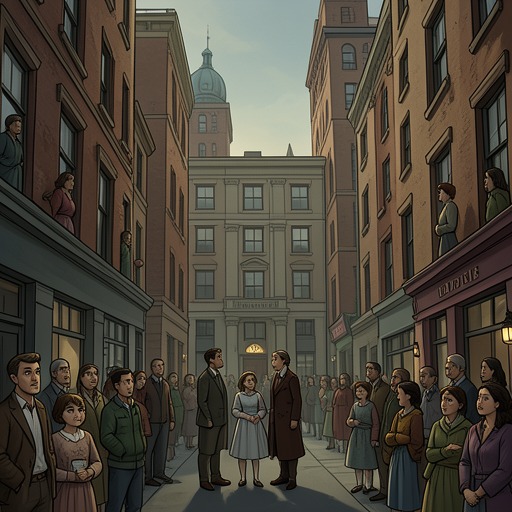
Terence's first day at school gives Mrs. Gottesmann's suspicions a new channel. After May enrolls him in a private day school by claiming that the Greenes are Christian Scientists and therefore do not want him subjected to medical examinations, the neighbors wait outside the building when May and Terence return. Mrs. Gottesmann demands to know whether it was his first day of school and asks Terence how he liked it. The questioning is public, performed before the other women, and May responds by placing a protective hand on the boy's thin shoulder while he imitates a normal human child by nodding and scuffing his shoe.
Her earlier conversations have already supplied Terence with the explanation the adults tried to conceal. He reports that he heard Mrs. Gottesmann tell Mrs. Schultz that the Greenes must be from Russia because they were so cagey about their origins. This revelation shocks May: she and Dan had believed that their unobtrusive behavior had made them inconspicuous, yet the neighbors had been suspicious all along. At the same time, May recognizes the accidental advantage. A suspicion that the Greenes are Russian provides camouflage, because it gives the neighbors an explanation that is false but familiar. Mrs. Gottesmann's gossip thus threatens the disguise while also protecting it.
The episode establishes the limits of ordinary surveillance. Mrs. Gottesmann sees secrecy, foreignness, and evasiveness, but she interprets them through the political and ethnic assumptions available to her. She does not discover Milotis; she helps construct a false story that allows Milotis to remain hidden.
Curiosity, Fear, and Misrecognition
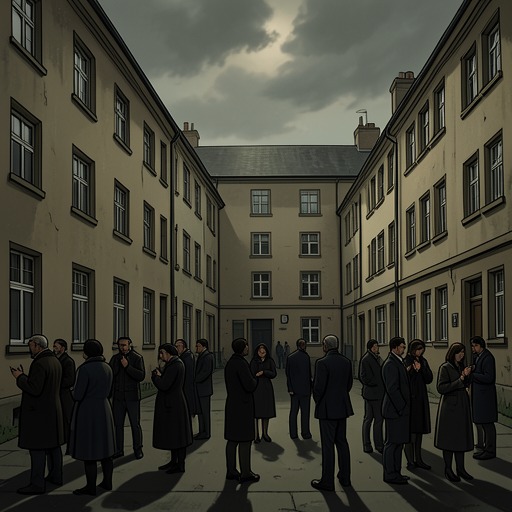
When May rushes from the apartment after receiving the principal's ominous message about Terence, Mrs. Gottesmann is stationed beside the front door with two companions. The women crane their necks toward May like hopeful vultures, eager to learn whether something has happened to the little boy. Mrs. Gottesmann asks whether something is wrong and suggests that the trouble may concern Terence, while Mrs. Schultz remarks that private schools are no good. May automatically denies that anything is wrong, maintaining the appeasing manner required by eighteen years of covert work among neighbors she does not trust.
Mrs. Gottesmann's role in this scene is not that of an informed investigator but of an audience hungry for confirmation. She senses crisis without understanding its nature. Her appetite for information intensifies May's fear, because any medical examination could reveal the masks, lenses, amputations, and biological adaptations that make the family appear human. Yet the neighbors' interpretive habits again protect the secret. At the school, the principal sees Terence's exposed body and calls him a freak, but then explains the impossible sight through rumors about bomb fallout and concealed mutations. The principal's fear turns alien biology into a familiar story about weapons, government secrecy, and radiation.
Mrs. Gottesmann belongs to the same social world of preexisting explanations. The Greenes are repeatedly recoded as Russian, mutated, or otherwise abnormal rather than recognized as inhabitants of another planet. Their safety depends not on perfect concealment but on the human tendency to prefer an available explanation over an unthinkable one.
Narrative Function and Significance
Mrs. Gottesmann is a recurring instrument of social pressure in the story's domestic setting. Her questions about May's tiredness, shopping, the roof, Terence's size, his school, and the family's country of origin create a chain of small exposures. None of these encounters independently reveals the truth, but together they show how the Greenes must manage accents, gestures, routines, family history, and the child's development. The apartment building becomes a front-stage environment in which every exchange can be overheard and reinterpreted.
She also embodies the difference between hostile scrutiny and genuine understanding. Her gossip is invasive, and her curiosity is often eager rather than compassionate, but she can express conventional kindness toward a child and concern when she thinks danger is obvious. That limited sympathy never reaches the family's real condition. In the final movement represented here, Terence clings tightly to May's hand after the school episode, and the closeness between mother and son is newly restored. Mrs. Gottesmann has not learned the truth, but her social pressure has helped drive the family toward a more honest inward bond: Terence begins asking May to tell him about Milotis, the place where everybody is like them.
The character's importance lies in this irony. Mrs. Gottesmann is one of the people most attentive to the Greenes and one of the least capable of seeing them. Her gaze produces suspicion without knowledge, and her mistaken explanations become part of the protective structure surrounding the alien family. Through her, the story presents ordinary neighborhood life as both surveillance and shelter: the same gossip that threatens exposure can bury the truth beneath the safer fictions of nationality, eccentricity, or mutation.